Identify the units before converting
Colons separate hours, minutes, and seconds. A decimal point separates the whole part of a chosen unit from its fraction.
A stopwatch reading
This site's online stopwatch shows hours, minutes, seconds, and thousandths of a second.
Open the stopwatchTime values in Excel
A cell's display format and its underlying numeric value are different things.
Microsoft's time conversion guide01
Read the display format first
Without labels, 01:30 is ambiguous. It could mean 1 hour 30 minutes or 1 minute 30 seconds. Check the units shown by your tool. This site's online stopwatch uses hours:minutes:seconds.milliseconds.
So 00:01:30.250 means 1 minute and 30.250 seconds, or 90.250 seconds in total. By contrast, 01:30:00.000 means 1 hour 30 minutes. The three digits after the point are a fraction of a second.
The decimal value 1.30 hours means 1 hour 18 minutes, because 0.30 × 60 = 18. Replacing a colon with a decimal point does not convert a duration.
Example. Label the result: 90.25 s, 1.5 min, or 1.5 h.
02
Convert the whole duration to one unit
For a duration containing hours, minutes, and seconds, use these formulas: total seconds = hours × 3600 + minutes × 60 + seconds; decimal minutes = hours × 60 + minutes + seconds / 60; decimal hours = hours + minutes / 60 + seconds / 3600.
2 minutes 45 seconds is 165 seconds, 2.75 minutes, or approximately 0.045833 hours. 1 hour 12 minutes 30 seconds is 4350 seconds, 72.5 minutes, or approximately 1.208333 hours.
For 90.25 seconds, divide by 60 to get approximately 1.504167 minutes. Keep the original seconds if you will use the result in more calculations.
Example. 00:02:45 = 165 s = 2.75 min. The unit changed; the duration did not.
03
Convert decimal values back to minutes and seconds
Keep the whole part of decimal minutes and multiply the remaining fraction by 60. For 3.4 minutes, keep 3 minutes and calculate 0.4 × 60 = 24 seconds. The result is 3 minutes 24 seconds.
For decimal hours, repeat the operation on the remainder. 1.375 hours contains 1 whole hour. The remainder gives 0.375 × 60 = 22.5 minutes, or 22 minutes plus 0.5 × 60 = 30 seconds. The result is 1:22:30.
Do not read 3.4 minutes as 3 minutes 4 seconds. The fraction is part of a minute, which contains 60 seconds.
Example. 3.4 min = 3 min 24 s; 1.375 h = 1 h 22 min 30 s.
04
Keep CSV seconds separate from Excel time
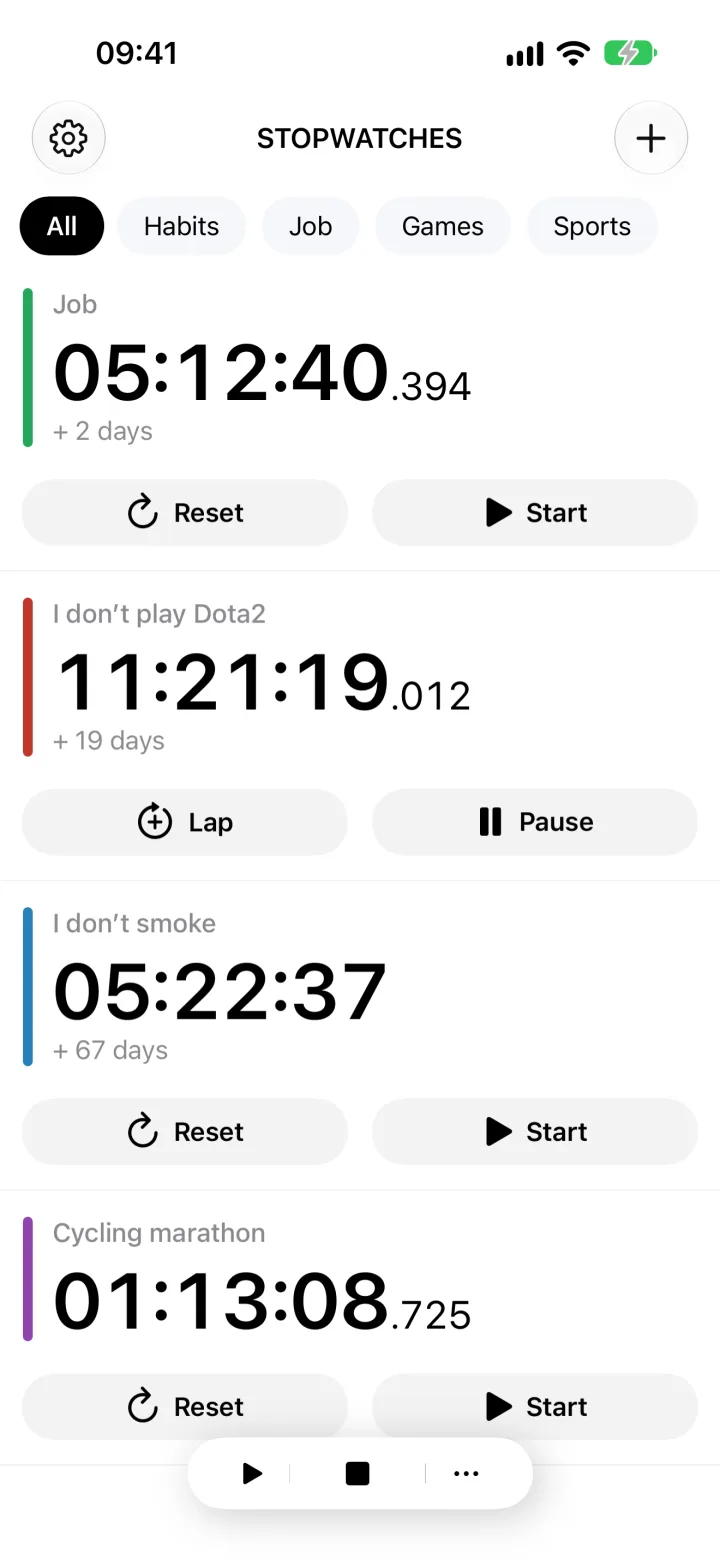
CSV exports from the Stopwatches app store durations in seconds. If A2 contains the numeric value 90, =A2/60 returns 1.5 minutes and =A2/3600 returns 0.025 hours. Use a number format for those results.
Excel stores numeric time as a fraction of a day. If A2 already contains a recognized duration of 00:01:30, =A2*1440 returns 1.5 minutes and =A2*24 returns 0.025 hours. These formulas require a numeric time value, not a text string containing colons.
Do not apply an Excel-time formula to ordinary CSV seconds. Changing the display format of 90 to a clock format also does not convert its units. Test with a known 90-second result to catch the difference.
If an import leaves a value as text, resolve the numeric conversion and decimal separator first. Keep the original CSV separately.
Example. Identify A2 as numeric seconds, an Excel time value, or text.
05
Round after adding the original measurements
Add the original seconds first, then convert the sum. Three intervals of 20 seconds total 60 seconds, exactly 1 minute.
If you round each interval to 0.33 minutes before adding, you get 0.99 minutes. The difference comes from rounding, not from the stopwatch.
For consecutive laps, add lap durations. Do not add cumulative timestamps measured from the overall start: that counts some of the same seconds repeatedly.
Example. 20 s + 20 s + 20 s = 60 s = 1 min.
Check one row by hand
Before calculating a whole list, check a known measurement.
- Label the source format and the result's unit.
- Convert a familiar duration, such as 1 minute 30 seconds.
- Confirm that the spreadsheet holds numbers rather than text.
- Add before rounding and keep the original measurements.
Two more conversion mistakes
Why is 0.01 minutes not one second?
One hundredth of a minute is 0.01 × 60 = 0.6 seconds. One second is 1/60 of a minute, approximately 0.016667 minutes.
Should I add a stopwatch total to its laps?
No, if those laps are included in the total. Use either the overall result or separate intervals that do not overlap. Adding a total to its parts counts the same time twice.
Stopwatches
Keep the original duration first
Stopwatches lets you record several measurements and export results to CSV. For a single measurement, start with the online stopwatch above.
Open Stopwatches on the App Store